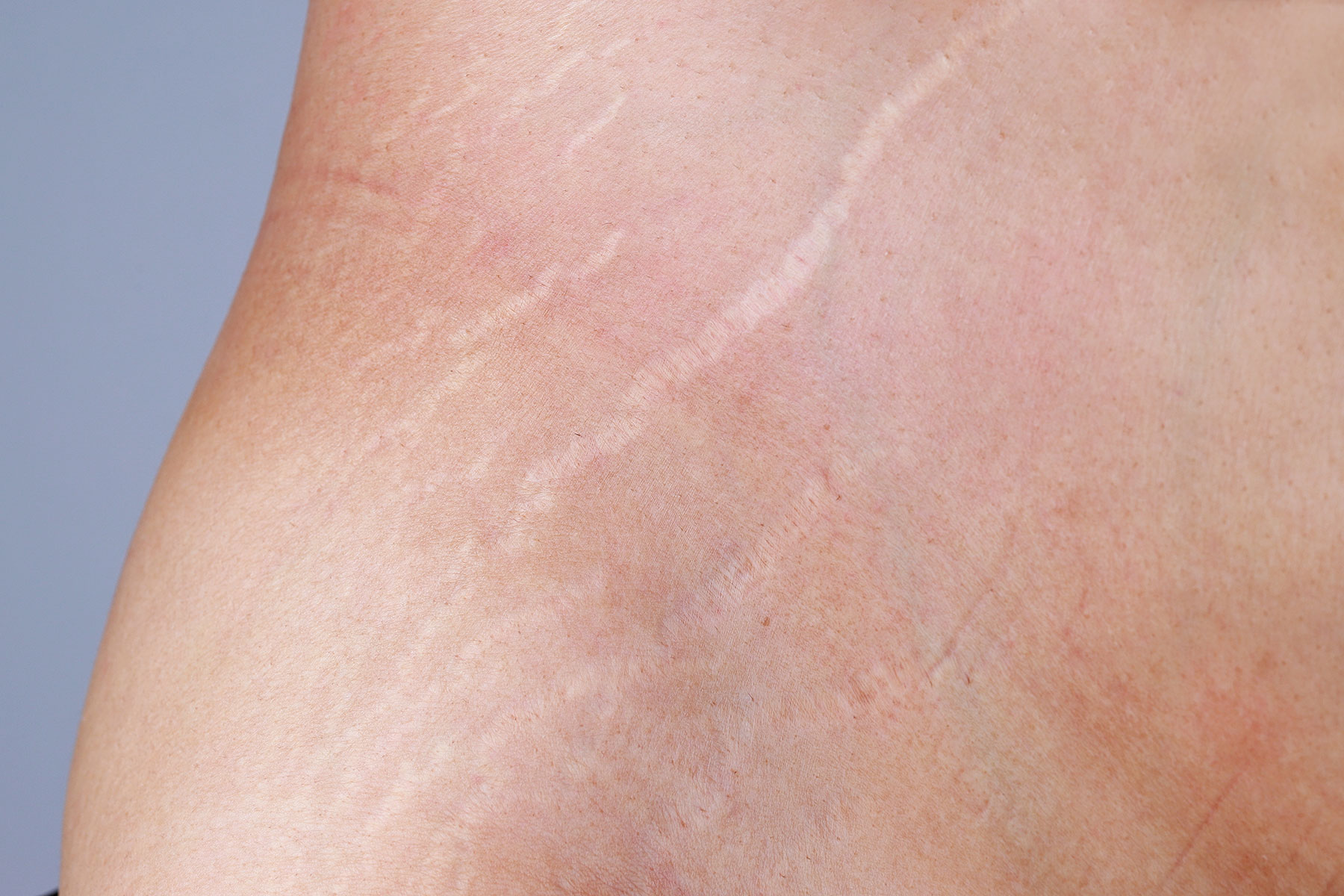
You’re standing in front of a mirror. The light hits just right—or maybe just wrong—and there they are. Those silvery, jagged lines across your hips or the deep reddish streaks on your stomach. We’ve been conditioned to think that seeing a nude with stretch marks is some kind of flaw or a "before" picture waiting for a laser treatment. But honestly? It’s just skin doing its job.
Most people feel like they’re the only ones. They aren’t.
According to research published in the Journal of Investigative Dermatology, roughly 50% to 90% of women develop striae (the medical term for stretch marks) at some point in their lives. Men get them too, especially during puberty or heavy lifting phases. It’s a biological reality. Yet, we spend billions of dollars trying to rub them away with cocoa butter that doesn't actually penetrate the dermis.
Let's talk about why we’re so weirded out by our own textures.
The Anatomy of a Stretch Mark: What’s Actually Happening?
Basically, your skin is an incredibly elastic organ, but it has its limits. When the body expands faster than the skin’s production of collagen and elastin can keep up with, the middle layer—the dermis—tears. That’s the "snap" you can’t feel, but eventually see.
When they first show up, they’re often called striae rubra. They look red, purple, or even dark brown because the blood vessels under the skin are showing through the tears. Over time, these fade into striae alba. These are the white or silvery lines that look a bit like scar tissue. Because they basically are scar tissue.
It's weirdly fascinating. Your body literally knitted itself back together after a growth spurt, a pregnancy, or a muscle gain.
If you look at the work of photographers like Jade Beall or the "Love Your Lines" campaign that went viral a few years back, you see a different perspective. They capture the raw, unedited reality of the human form. When you see a high-resolution photo of a nude with stretch marks, you aren't seeing a "damaged" body. You’re seeing a body that has lived. It’s texture. It’s depth. It’s like the grain in a piece of oak or the patina on vintage leather.
Why the "Erasure" Culture is Failing Us
We’ve been sold a lie by airbrushing. For decades, every magazine cover and every "perfect" Instagram post featured skin that looked like polished plastic. This created a massive psychological gap. People would look at a nude with stretch marks in their own bedroom and feel a sense of shame, purely because the media they consumed was physically impossible.
Even the "body positivity" movement sometimes misses the mark. It often focuses on "loving" the marks, which can feel like a lot of pressure. Sometimes, you don't have to love them. You can just... accept them. Body neutrality is a much more sustainable goal. Your skin protects your organs. It regulates your temperature. If it has some lines on it because you grew a human or grew some quads, that’s a fair trade.
The Science of "Treatment" (And Why Most of It is Junk)
Let’s get real about the creams.
- Topical oils and creams: Most studies, including those reviewed by the American Academy of Dermatology, show that things like almond oil, cocoa butter, and olive oil don't actually prevent or "cure" stretch marks. They might make your skin feel soft, which is nice, but they aren't reaching the dermis.
- Retinoids: Prescription-strength Tretinoin (Retin-A) has shown some success in improving the appearance of early (red) stretch marks by rebuilding collagen. But you can't use it if you're pregnant or nursing.
- Laser Therapy: This is the big guns. Fractional CO2 lasers or Pulsed Dye Lasers can help fade the color and improve texture. It’s expensive. It takes multiple sessions. And even then, it usually doesn't make them 100% disappear.
Honestly, the most effective thing you can do for your skin's elasticity is stay hydrated and maintain a stable weight when possible, though genetics usually have the final say anyway. If your mom has them, you probably will too. Thanks, DNA.
Real Stories: Beyond the Airbrushed Image
I remember talking to a competitive bodybuilder who had deep marks across his pecs and shoulders. He called them his "growth rings." He wasn't ashamed. To him, those lines were proof of the years he spent in the gym, pushing his physical limits. When he stood nude with stretch marks during his prep, he saw them as badges of effort.
Then there’s the postpartum perspective. A friend of mine struggled for years with the change in her stomach texture. She told me she felt like she’d lost her "smooth" self. But then she realized her kid thinks her stomach is the softest, safest place in the world. The kid doesn't see "striae distensae." The kid sees Mom.
It’s all about the lens.
Navigating Intimacy and Self-Image
It is completely normal to feel vulnerable when someone else sees you. The fear of judgment is real. But here is a secret: most partners aren't looking for flaws. They’re looking at you.
In a 2023 survey regarding body image and attraction, a staggering majority of participants noted that "perceived flaws" like stretch marks or scars didn't actually impact their level of attraction to a partner. Often, we are our own harshest critics. We zoom in on a 2-inch square of skin and forget the rest of the person exists.
If you’re struggling with this, try "mirror exposure" therapy. It’s a technique used by psychologists where you look at your body in a neutral way. Not to compliment it. Not to insult it. Just to describe it. "I have lines on my hips. They are silver. They reflect the light." This strips the emotional power away from the "flaw" and turns it back into just... skin.
The Future of Texture in Media
We are seeing a shift. Brands like Dove and even some high-fashion labels are starting to stop the heavy retouching. Seeing a nude with stretch marks in a major ad campaign used to be a "statement." Soon, it will just be normal.
The more we see real skin, the less we’ll feel the need to hide it. We’re moving toward a world where "perfect" is boring and "real" is the standard.
Actionable Steps for Skin Health and Confidence
If you want to take care of your skin or change your mindset, don't just buy the first "miracle cream" you see on TikTok.
- Focus on the Dermis: If you’re serious about treatment, see a dermatologist. Ask about Microneedling or Radiofrequency treatments. These actually create controlled micro-injuries to trigger real collagen production deep down where the mark lives.
- Hydrate from the Inside: No amount of lotion replaces drinking water and eating fats like omega-3s that support skin barrier health.
- Curate Your Feed: If you follow accounts that only show filtered, blurred skin, unfollow them. Seek out photographers and creators who celebrate "skin hunger" and real textures.
- Practice Neutrality: Next time you’re getting ready, catch yourself when you start a negative thought loop. Replace "My skin looks ruined" with "This is what skin looks like after growth."
Your body isn't a museum piece meant to stay in pristine condition forever. It’s a tool. It’s a vessel. It’s going to get some dings and scratches along the way, and that is exactly how it's supposed to be.
Stop waiting for your skin to be "perfect" before you start living in it. The lines are already there; you might as well get used to them. They aren't going anywhere, and honestly, they don't need to.
Next Steps for Better Skin Health
To truly support your skin's resilience, focus on consistent sun protection—as UV damage breaks down the very collagen you need to keep skin firm—and consult with a board-certified dermatologist before starting high-strength retinoid cycles.